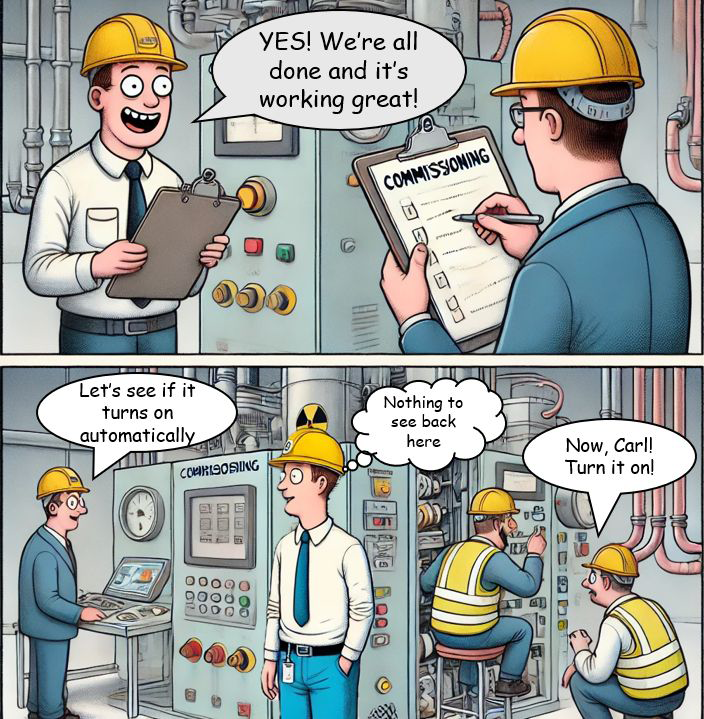
Is it “Done,” or is it “Done-Done”?
In the construction world, the term commissioning is used to verify that infrastructure systems (mechanical, electrical, plumbing…etc.) are installed to spec and working as designed. Commissioning comes in when the sub-contractor teams say they’re “Done” to verify that all the “i’s” have been dotted and all the “t’s” have been crossed. The Commissioning report tells the owner the construction project is “Done-Done.”
This process works well for new construction, but the minute the building goes into operation, “done” becomes relative at best, and irrelevant at worst. Things quickly become “undone” as systems are overridden to accommodate occupancy needs that hadn’t been considered during the course of construction. Sometimes, items get missed completely during the check-out process and owners have to begin calling sub-contractors back to re-do work while it’s still under warranty.
Validating value
The commissioning process is invaluable to new construction, even if it is sometimes imperfect. For buildings that have been operating for any amount of time, another kind of commissioning can bring even more value to owners and operators. Sometimes referred to as continuous commissioning, monitoring-based commissioning or even ongoing commissioning, this data-driven approach utilizes the same oversight process as new construction commissioning but through the analysis of real-time operational data rather than sub-contractor self-reporting.
With continuous commissioning, a live data-feed enables operators and their service providers to receive and normalize interval data from any operational system. A rules library, or set of algorithms typically called Fault Detection and Diagnostics, runs through this data to identify regular operating conditions and highlighting anomalies. So much more than a moment-in-time verification, continuous commissioning trains a consistent set of (machine learning) eyes on your operational data and produces reports based on the parameters and conditions written into the rules themselves. This report is auto-generated on a consistent timeframe and doesn’t require any site visits to produce!
The real magic happens when you take this data-driven approach and put it in the hands of energy engineers and analysts. Using these reports and the algorithms that produced them, energy engineering expertise is put to work prioritizing the most impactful adjustments and assisting through the resolution process. Rather than marking an item “done” in a cloud-based checklist, this approach creates continuous ROI, prevents improvements from becoming “undone” or drifting out of optimization. Most importantly, it gives facility management teams both the tools and the expertise to manage and improve the performance of their facilities.
Data Driven Continuous Commissioning identifies anomalies and patterns not visible to us humans, making our work easier, faster, and more accurate. Done and DONE!
Data doesn’t lie, and you can’t hide from it…Carl.
Visit us at InSite and see how we take your building data and turn it into a 2x ROI.