
Building owners have found themselves at the crossroads of emerging challenges tied to cost efficiency and portfolio-level goal attainment. At the same time, their operators struggle at balancing their demands of optimizing safety, occupant comfort, and resource management, such as equipment maintenance. The built environment is seeing these pressures collide as sustainability and, more specifically, operational performance goals come to the forefront.
Data-Driven Strategies for Building Operations
The demand for sustainable practices is escalating across industries, and occupants are becoming more vigilant about indoor air quality issues. It’s well understood that energy consumption reductions result in numerous operational benefits that can transfer to tenant benefits, but as any facility manager will attest there’s more to energy efficiency than merely demonstrating responsible intentions. All the while, prioritizing tenant comfort remains a top priority. Consequently, the implementation of effective maintenance procedures becomes crucial. Utilizing data to meet the requirements of all building stakeholders (e.g. tenants/occupants, operators, owners, and investors) is more critical than ever.
Monitoring Based Commissioning (MBCx)
Buildings’ systems, much like their structures, exhibit a documented tendency to degrade over time, traditionally addressed through periodic recommissioning (RCx). However, such corrective measures often lack persistence.
‘Ongoing’ or ‘Monitoring Based’ commissioning (OCx/MBCx) is the practice of leveraging building data, often supplied by the Building Automation System (BAS), to perform perpetual commissioning of the system. Its impact builds on the fundamentals of RCx by continually addressing system degradation.
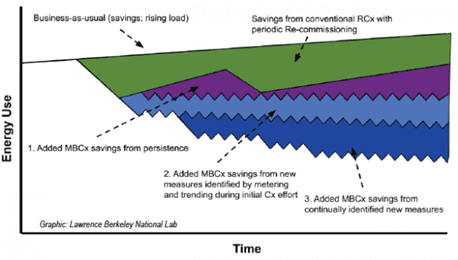
The goal of MBCx remains the same as that of RCx; to fix broken systems and optimize functional ones. The introduction of data allows for this process to be automated, on an ongoing basis, and can be performed in a far more efficient manner than historically possible.
Fixing Broken Systems– Automated Fault Detection and Diagnostics
HVAC systems are complex, constituted by dozens or hundreds of physical control endpoints in the building with each having a finite life expectancy. As such, these systems often encounter faults that can greatly impact energy use, comfort, or both.
A 2023 study by Lawrence Berkley National Laboratory (LBNL) on over 60,000 pieces of HVAC equipment found that “On any given day, 40% of AHUs and 30% of air terminal units saw a reported fault of some kind” (Crowe et al, 2023).
Early MBCx efforts were focused on analyzing BAS trends to identify deficiencies or opportunities for optimization. These efforts inundated in-house facilities teams or commissioning engineers as it required spending hours clicking through trends to identify deficiencies. More recently, software solutions have been developed that collect and analyze building data for specific deficiencies and opportunities. These solutions are typically referred to as ‘Automated Fault Detection and Diagnostics’ (AFDD) software.
AFDD works by defining a set of parameters within the software which, when met by the data, gets flagged for user-review. Uncovering suboptimal performance and vital issues once took a seasoned engineer days or weeks to reveal, however software tools can continually monitor this data automatically and alert users to reduce or prevent negative impacts on building operations.
This approach has been proven to drastically improve the energy performance of buildings. A 2019 publication by LBNL found that FDD users in the office and higher education market sectors of the United States were able to achieve 10% median energy savings annually with a two-year simple payback period (Kramer et al, 2019).
Furthermore, more holistic sustainability solutions leveraging AFDD enable deficiency prioritization in terms of their effect on comfort levels, cost savings, or sustainability goals to achieve the biggest impacts first. Service technicians can spend time fixing problems instead of finding them. Maintenance efforts can start to shift from reactive to proactive.
Optimizing Functional Systems – Optimization Opportunities
As faults are resolved, new optimization opportunities emerge. The same building data that we analyze for fault prevalence can be used to benchmark equipment performance against industry standards and best practices, such as ASHRAE Guideline 36: High-Performance Sequences of Operation for HVAC Systems, published in 2021.
With accurate building data, we can begin to align building operations with tried-and-true industry best practices. Deviations from the standard can be discovered, and the operational data can be used to qualify and quantify potential impacts. From here, decision makers can prioritize their optimization projects based on things like GHG reductions or financial savings.
Measurement and Verification of Results
Once we’ve addressed deficiencies through AFDD software and seized optimization opportunities, the data becomes instrumental in performing accurate measurement and verification of the implemented optimizations. This phase is crucial for assessing the real impact of our efforts, ensuring that the envisioned energy efficiency, enhanced comfort, and cost-effectiveness are not just theoretical goals but tangible outcomes. By leveraging accurate building data, we can precisely measure the success of our optimization projects and provide a comprehensive understanding of their effectiveness allowing for informed decision-making in the ongoing commitment to smarter, sustainable building management.
Conclusion
The integration of data-driven strategies in building management is pivotal for advancing sustainability, enhancing occupant comfort, and ensuring operational efficiency. Monitoring Based Commissioning (MBCx) with its perpetual approach, coupled with Automated Fault Detection and Diagnostics (AFDD) software, not only addresses system degradation but also allows for prioritized and proactive maintenance. The identification of optimization opportunities through accurate building data aligns operations with industry best practices, contributing to significant impacts such as energy savings, and regulatory compliance with building performance standards. By embracing a data-centric approach, building owners and operators can foster a sustainable, comfortable, and efficient environment that meets the evolving demands of every building stakeholder- from occupant to owner.
References
Crowe, E., Chen, Y., Reeve, H., Yuill, D. P., Ebrahimifakhar, A., Chen, Y., Troup, L., Smith, A. D., & Granderson, J. (2023). Empirical analysis of the prevalence of HVAC faults in commercial buildings. Science and Technology for the Built Environment, 29(10), 1027–1038. https://doi.org/10.1080/23744731.2023.2263324
Kramer, H., Lin, G., Curtin, C., Crowe, E., & Granderson, J. (2019). Building analytics and monitoring-based commissioning: industry practice, costs, and savings. Energy Efficiency, 13(3), 537–549. https://doi.org/10.1007/s12053-019-09790-2
Mills, E. (2011). Building commissioning: a golden opportunity for reducing energy costs and greenhouse gas emissions in the United States. Energy Efficiency, 4(2), 145–173. https://doi.org/10.1007/s12053-011-9116-8
ASHRAE. 2021. ASHRAE Guideline 36 – High Performance Sequences of Operation for HVAC System. Atlanta, GA: American Society of Heating, Refrigerating and Air-Conditioning Engineers, Inc.