You may remember building operations being tough to manage during the Covid-19 pandemic. At first, HVAC systems and ventilation strategies were scrutinized for their potential to spread the virus. Then, offices were closed completely as shelter-in-place orders spread across the country.
Many in the industry joked that energy savings would skyrocket but in reality, most building systems like HVAC were left operating as if they were heating and cooling fully occupied buildings. That’s because despite it seeming counterintuitive, it isn’t the best idea to just turn off mechanical equipment. Some facilities managers learned that the hard way when they went to turn on systems and were greeted with countless problems.
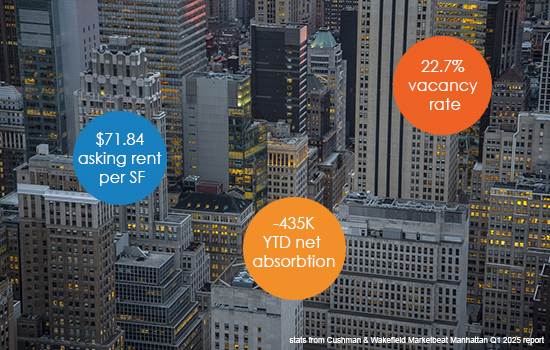
Today, office buildings are facing a similar question of how to run empty, or nearly empty buildings. The pandemic is over, but occupancy for commercial real estate may be forever impacted. This period of low lease rates and highly variable office attendance requires a shift in the way buildings are run to avoid adding to accumulated losses in the office building sector.
Even with varying degrees of occupancy and rising energy rates, building owners and operators have options even when vacancy rates prove sticky. In this article, we explore a few best practices for operating buildings with high vacancies. Following these recommendations and implementing these energy management strategies will reduce peak loads, lower utility bills and keep equipment running for longer, limiting an asset value backslide.
Setback operation basics
Spaces that are infrequently or intermittently occupied offer a valuable opportunity for energy savings and reduced equipment runtime. Effective energy conservation in these areas isn’t simply about “turning things off,” but rather placing systems into an unoccupied or setback mode.
In unoccupied mode, HVAC systems allow the indoor conditions to drift further from typical comfort setpoints by widening the acceptable temperature range. Systems remain inactive unless indoor conditions move beyond these relaxed limits. If they do, the system engages in setback operation—reconditioning the space just enough to stay within the expanded range.
Benefits of setback operation
Setbacks deliver several key benefits:
✅ Thermal stability: Prevents spaces from overheating or overcooling, which could affect neighboring areas.
✅ Rapid recovery: Allows conditions to be quickly restored if the space becomes occupied again.
✅ Air quality maintenance: Helps manage humidity and air freshness without the cost of full operation.
Setback operation is more efficient than standard occupied operation because unoccupied spaces do not require ventilation. Ventilating with outdoor air during extreme weather is energy-intensive and often represents over 10% of a commercial building’s total energy use. By avoiding unnecessary ventilation, setback modes help reduce overall energy intensity.
Typical unoccupied setpoint thresholds:
- Heating: 60°F (15.5°C)
- Cooling: 85°F (29.5°C)
Scheduling setbacks
Setback strategies are typically implemented via scheduling in the Building Automation System (BAS). In many cases, both occupied and unoccupied zones are served by shared equipment—such as an Air Handling Unit (AHU). Even in these scenarios, zone-level scheduling allows unoccupied zones to operate under relaxed setpoints, while occupied zones continue to meet their stricter ventilation and comfort requirements.
The upstream AHU can continue to operate on a standard schedule but will do so more efficiently, supplying only the necessary ventilation and conditioning for the occupied zones.
Optimizing setbacks for seasonal conditions
Summer considerations
In warm weather, HVAC systems not only cool the air but also remove humidity. During setbacks, unventilated or lightly conditioned spaces may experience humidity buildup due to infiltration, potentially leading to mold and indoor air quality issues.
Recommendations:
- Install humidity sensors in critical spaces.
- Enable setback cooling to activate if relative humidity exceeds 60%.
- Where sensors are unavailable, conduct regular inspections with portable humidity meters.
- If high humidity is detected, lower the unoccupied cooling setpoint to 80°F (26.7°C) to promote more frequent dehumidification.
Winter considerations
Cold climates present a different challenge—freeze risk, particularly for systems using hydronic coils (hot/chilled water). Freezing water can rupture coils and damage equipment.
Common freeze protection strategies include:
- Freezestats: Mechanical sensors that open heating valves when coil temperatures drop near freezing.
- Freeze protection pumps: Circulate water through idle coils during freezing conditions.
- Glycol mixtures: Lower the freezing point of the fluid in hydronic systems.
- Heat trace: Electrically warms exposed piping to prevent freezing.
- During extreme winter setbacks, these freeze protection systems should be regularly tested, monitored, and recommissioned to ensure reliable operation.
High vacancy, low energy
Low occupancy obviously isn’t part of your long-term strategy, but recognizing that your building operations can and should change when lease rates fall is a big step in hedging against major losses. These energy management best practices for empty or partially empty buildings – from setbacks and scheduling to low-cost monitoring sensors – will ensure that this challenging period doesn’t have lasting impacts on your total asset value.
If you’re looking for help implementing these strategies with your property management teams, reach out to InSite. We’ll be glad to evaluate your current lease rates and propose an energy management strategy that will work for your specific situation.
About InSite
Founded in 2013, InSite is a leading solution partner for optimization in buildings, extracting value from data to engineer meaningful outcomes for its clients. We deliver financial and operational impact by harnessing our team’s expertise in engineering and building performance optimization. Our Engineered for Results approach combines an intelligence platform that collects and analyzes data for single buildings and entire portfolios with our program management teams who transform data into prescriptive recommendations.