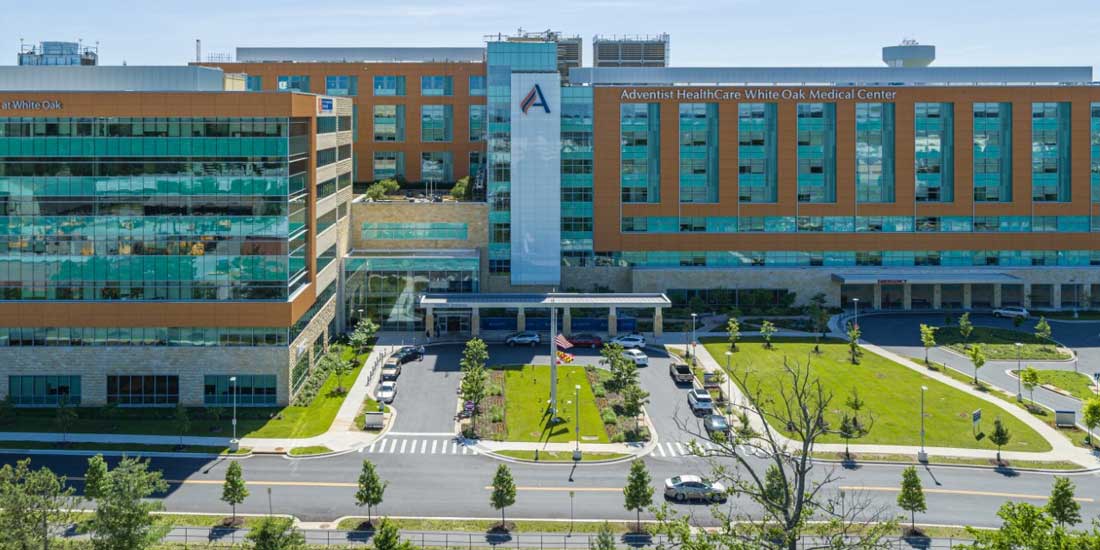
White Oak Medical Center hospital (“WOMC”) is a 576,000 square foot hospital built in 2019 by Adventist HealthCare. Over the first few years of operation, the hospital built out and opened three new patient floors and saw its patient base grow.
In 2022, although only a few years old, the WOMC facility engineering team started to experience issues with major air handling units including unexplained shutoffs, pressure variances in duct work and in downstream zones, and economization sequences not performing in line with design intent. This is common, where actual equipment operation causes variances in equipment performance that wasn’t, or couldn’t have been, accounted for in design, construction and commissioning stages. And it’s exactly what post-occupancy commissioning – referred to by many names like retro-commissioning, monitoring-based commissioning and ongoing commissioning – is intended to solve.
For more than 15 years, InSite has worked with facilities teams at various Adventist HealthCare locations, so when WOMC was completed, the Managed Services team rolled the facility into its ongoing retro-commissioning and systems optimization program. This starts with a connection to all Building Automation System (BAS) and energy interval data at the site. InSite then implements fault detection and diagnostics (FDD) software to identify energy savings opportunities as they occur, as well as to verify implementation of recommended measures and the persistence of savings.
The hospital leveraged InSite’s data-driven approach to build a business case for retro-commissioning (RCx). In it, the team:
- identified air handler energy conservation measures,
- provided feedback on sequence adjustments and air balancing in weekly commissioning meetings throughout the RCx process,
- validated operational savings after project completion,
- and packaged post-implementation data into rebate applications.
Making the case for RCx
A cornerstone of the business case for retro-commissioning at the WOMC site was air handler sequence of operation in winter. In working closely with the facility engineering team, a pattern emerged – there was consistent trouble restarting units that were taken offline for maintenance.
The engineers also noticed air handlers would trip offline on a low temperature alarm even when none of the alarm conditions were true.
InSite’s energy engineers observed these performance issues through the FDD system, too. The airflow dampers weren’t controlling airflow as expected – the damper position did not correspond to the correct airflow. During winter months, data showed units with outside air dampers fully open that were pulling in too much outside air, causing the system to incur a heating penalty. Moreover, damper calibration issues were creating static pressure variances within the duct work, leading to higher supply fan outputs.
Initially, to ensure pressure and airflow setpoints were maintained, the facility engineering team overrode the incorrect sequences and operated dampers and chilled water vales manually. But this created an unintended energy penalty for overcooling because the air handlers were cooling when loads were low or through winter weather events. This override also caused downstream boxes to work harder with additional reheat to overcome the lower supply air temperatures from the source air handlers.
InSite documented these anomalies with BAS trend data and calculated annualized savings values for:
- missed and inopportune economization,
- overcooling due to chilled water valve manual operation,
- and lower fan speeds with static pressure resets.
The total annualized value of the energy conservation measures for the project was $136,000. The hospital facility engineers used these operational savings with anticipated utility rebates to help justify engaging a retro-commissioning agent.
Implementing the RCx plan
A retro-commissioning plan was created to first stabilize, then optimize, the major air handling units at the hospital over the course of four months. A cooperative team comprised of the RCx agent, hospital facility team, InSite managed services team, and hospital building automation system vendor met weekly throughout the project.
Units were serviced in batches of 4-5 at a time due to the hospital’s schedule. InSite’s FDD results and trend data were used in these weekly meetings to provide feedback on sequence adjustments and to track performance improvements. FDD helped to spot discrepancies with global outside air temperature and humidity values that were referenced by air handling units for sequences.
InSite used the data to feed a traffic light chart that tracked progress for each air handler against program KPIs such as: static pressure setpoints, temperature setpoints, fans not operating at max output, and damper calibration. The teams took various measures to help stabilize the air handlers and improve their reliability including:
- extending supply fan ramping to reduce speed changes,
- changing the reference point for low temperature alarms,
- adjusting damper sequence upon start up to open slower and avoid safety shut offs,
- cleaning outside air intakes,
- and balancing dampers along with airflow stations.
After stabilizing the units and restoring the facility team’s trust in their operation, the process of optimizing their sequences began. Sequences in winter weather were modified to prevent excess outside air intake in extreme conditions and to allow the units to better handle temperature resets in low load. The economization sequences were restored to the design intent and dampers were released to move in auto rather than manual operation. RCx agents also worked with the BAS vendor to change the reference weather points for more accurate control. InSite provided the WOMC facility engineering team with real-time feedback through final adjustments with trend data that showed the improved performance of units across datapoints including free cooling and adherence to pressure and temperature setpoints.
At the conclusion of the project, InSite began the measurement and verification process to validate the original projected energy savings. Using its FDD software again, the InSite energy engineering team analyzed data trends through different seasons and temperature ranges. Then, the program team bundled the M&V report with the energy conservation measures and a narrative of the project into rebate applications for the electric and gas utility providers.
To date, the project has been approved for monitoring based commissioning incentives worth $188,000; bringing the total operational savings plus rebate benefit for the White Oak Medical Center hospital to over $324,000. It’s a tremendous display of the power of FDD software, a strong retro-commissioning team approach and dedicated facility engineers to both improve equipment operation and deliver meaningful revenue back into their organizations.
About InSite
Founded in 2013, InSite is a leading solution partner for optimization in buildings, extracting value from data to engineer meaningful outcomes for its clients. We deliver financial and operational impact by harnessing our team’s expertise in engineering and building performance optimization. Our Engineered for Results approach combines an intelligence platform that collects and analyzes data for single buildings and entire portfolios with our program management teams who transform data into prescriptive recommendations.